The RECREATIONAL CRAFT REGULATIONS, or RECREATIONAL CRAFT DIRECTIVE as it used to be known, is a grey area for quite a few people. The Direct Gov website introduces these regulations by stating: the Recreational Craft Regulations 2017 implement Directive 2013/53/EU on recreational craft and personal watercraft. The EU Withdrawal Act 2018 preserved the 2017 Regulations and enabled them to be amended so as to continue to function effectively now the UK has left the EU. Many of the grey areas are being tightened up, as a result of the UK’s withdrawal from the EU. We are monitoring this situation as best we can, but please be aware that the following information is subject to change, without notice to us or you as a consumer.
There is a lengthy document, available to read by the public, from the Direct Gov website, but in short the regulations ensure that private craft built since 1998, in use on UK waters, are compliant with UK safety regulations. When boats are compliant, they will carry a CE or UKCA mark, along with a Waterways Identification Number (WIN). Boat builders can legally self-declare their boat is compliant, without any additional need for assessment. There is also a specific way for completed craft to be assessed called a Post Construction Assessment, if you are not the original builder. The Regulations place the responsibility of ensuring the craft meets all the requirements of the RCD upon the person who first places the craft on the market.
Buying a compliant craft:
Anyone thinking of buying a boat, new or used, should look for these items:
- A builders plate
- A CE mark (often on the builders plate)
- A Waterways Identification Number (WIN), previously known as a Craft Identification Number (CIN) or Hull Identification Mark (HIN).
- An owner’s manual with a copy of a declaration of conformity (required on new boats, but is often misplaced at subsequent sales).
- Boats must also comply with the Boat Safety Scheme (BSS) requirements before they can be used on most of the UK’s waterways. Look at the BSS web site for more information.
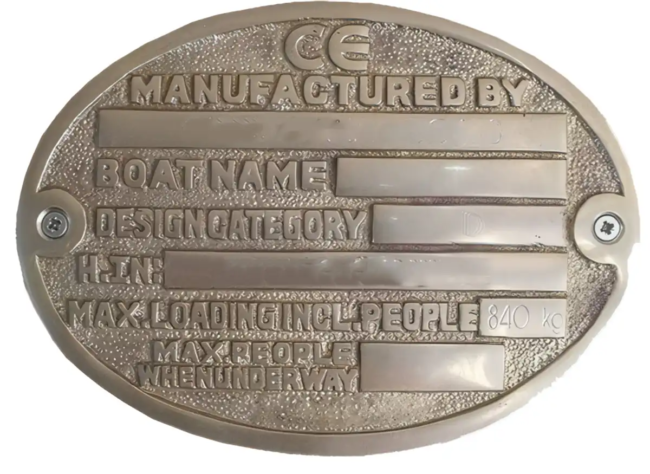
Builder’s Plate
Every boat built since 1998 must have a builder’s plate. This plate has the maker’s details and technical information such as the design category, and maximum loading weight. It must also include the CE mark, and often will include the WIN.
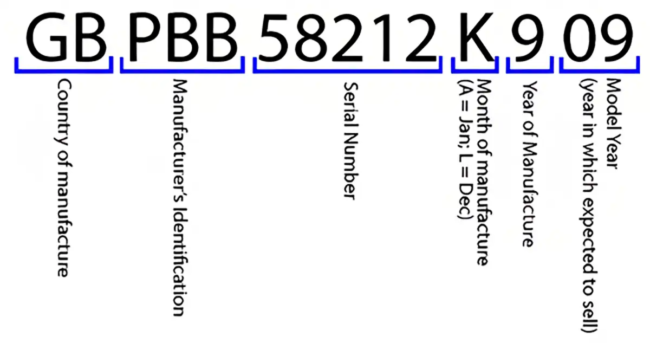
Waterways Identification Number (WIN)
The Waterways Identification Number, Craft Identification Number (CIN) or Hull Identification Number (HIN), is unique to that craft. It is a code that identifies not only the builder, but where and when the craft was built. It will look similar to the illustration below and should always be 14 alphanumeric characters in length, no more and no less. The “Model Year” must always be of equal or later date than the year of manufacture, never earlier.
Owner’s Manual
Brand new boats must have an owner’s manual. As all the required information is in the original owners manual, always ask to see it. You should also have the manuals for any equipment fitted for the same reasons. The owners manual must also contain an important legal document called a Declaration of Conformity. This document is issued and signed by the manufacturer, or his agent or the importer.
Secondhand boats ‘should’ have this paperwork, but doesn’t always. Some owners are meticulous with their paperwork, keeping every receipt, document and manual. Other owners are less so.
Some craft do not need to be CE marked:
Any craft already in use before 16th June 1998, unless its main use becomes recreational after this date (ie. from a working boat for coal to a live aboard home).
Any craft under 2.5m or over 24m.
Any craft on the list of exemptions and, usually labelled such as racing boats, historic craft and hovercraft.
However in most cases the exemption has conditions. A craft can lose the exemption if the conditions are broken and will need to meet the full requirements of the RCR.
This is a complex area to give general advice on. Each case has to be examined and decisions made on an individual basis.
Advice
All recreational craft built since 1998 must comply with the Recreational Craft Regulations. Boats must comply with either the original, or 2017 version of the regulations, depending on year of build.
Buy through a broker, who is also a member of the BMF or ABYA.
If you buy privately – buyer beware! Check everything very carefully and have a survey done. If the craft does not comply with the RCR and does not fall into one of exemptions, walk away. Some bargains are not worth it!
This information has been adapted from the Direct Gov website. It is designed to provide basic information to consumers. It is not a complete or authoritative statement of the law, and the law could change without notice to us or you as a consumer. If in doubt, speak with the British Marine Federation (BMF) for sound legal advice. Unfortunately, we are unable to give any further advice, and cannot be held responsible for any incorrect advice.
Thinking of selling your boat?

We’re here to help
Looking for Boat Insurance?

Subscribe to listings updates
Get a notification when new boats are advertised.
Rugby Boats Ltd
Stowe Hill Wharf
Heyford Lane, Weedon,
Northants, NN7 4SF


